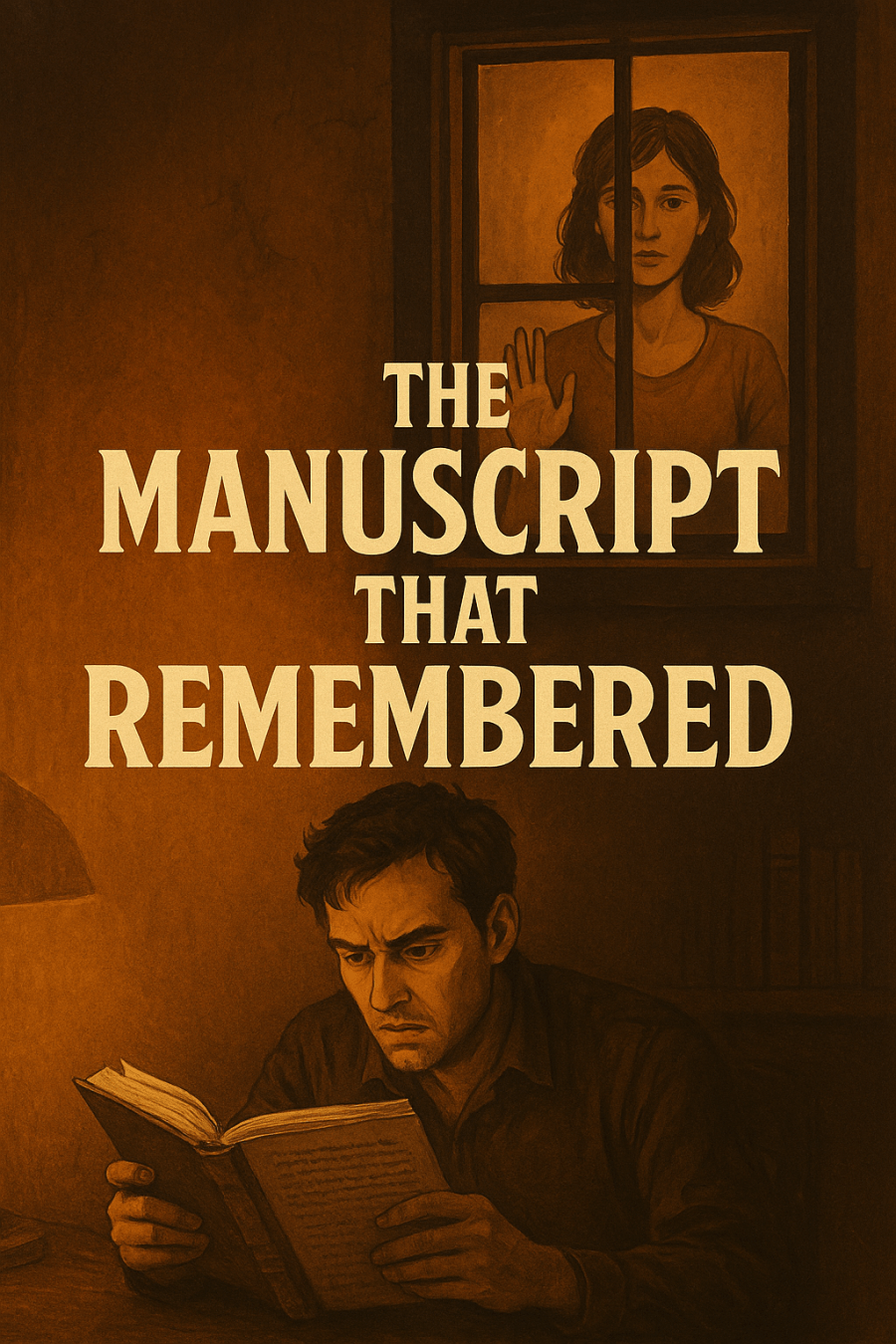
The Manuscript That Remembered
A Short Story by Vasu Gangapalli
Aarav Mehta had always believed stories chose their writers—not the other way around. At twenty-seven, celebrated for his debut book and adored online, he carried an insecurity no one ever saw: What if he never wrote anything remarkable again? Praise felt temporary. Applause faded. Blank pages terrified him.
So when a dusty brown package arrived on a monsoon evening, addressed strangely to “The Writer Who Will Understand,” Aarav felt a pull he couldn’t explain.
Inside was a thick, hand-bound manuscript titled The Unfinished Room. No author name. No date. No note. Not even a hint of where it came from.
He should’ve been alarmed.
Instead, something in him whispered—read it.
By midnight, his room smelled of coffee and rain as he turned page after page. The story followed a young woman named Mira who lived in a locked room and communicated only through a window. She spoke to a man who visited her every evening, though he was never named. The writing was hauntingly intimate, as if the author had bled loneliness into every sentence.
Halfway through, Aarav found himself touching Mira’s name on the page.
Softly, he whispered, “Who wrote you, Mira?”
The ceiling fan hummed back, almost as if urging him deeper.
The next morning, craving fresh air, Aarav went to his window. That’s when he froze.
A girl was standing in the window of the opposite apartment—looking directly at him. Her hair was tied exactly the way Mira’s was described: messy, but intentional, as if she was always in a hurry to appear calm.
She lifted her hand and waved.
Aarav stepped back, heart thudding.
“No… you’re just tired,” he muttered. When he looked again, the window was empty.
But the image stayed with him: those soft eyes, that fragile expression.
She looked like Mira.
Days passed. Aarav read the manuscript obsessively. He stopped answering calls, missed deadlines, ignored texts—even from his mother. Every time he reached a window scene in the manuscript, he would glance at the opposite building.
And almost always, he saw her.
Sometimes a silhouette.
Sometimes just her reflection.
Sometimes her eyes, watching him.
His heartbeat quickened each time.
Is she real? Or am I losing myself inside this story?
One evening, as rain battered the city, his best friend Rhea barged into his flat.
“Aarav!” she exclaimed. “You look… I don’t even have a word. What’s going on with you?”
“I’m writing,” he said, avoiding her eyes.
“You haven’t sent a single chapter in two months!”
He hesitated. “Someone sent me a manuscript.”
Rhea frowned. “A manuscript? From who?”
“I don’t know… but it’s brilliant. Unsettling. Too real.”
“Let me see it.”
“No!” He hugged it to his chest. “You won’t understand.”
“Aarav…” She softened. “I’m worried. You’re acting like this book owns you.”
He laughed uneasily. “Maybe it does.”
Later that night, while rereading a section, he noticed something he swore wasn’t there earlier—a line describing the unnamed man who visited Mira:
He lived alone, wrote stories for a living, and stared at her from the opposite window.
Aarav’s breath hitched.
“No… that wasn’t here. I know it wasn’t.”
His fingers trembled as he flipped through the pages. Then another line struck him cold:
Mira waited for him every night. Even though he didn’t know she existed beyond the page.
Was someone playing a prank on him?
Or… had the story changed?
At 3 a.m., unable to fight the pull, Aarav walked to his window. She was there again—Mira, or the girl who resembled her—standing in her window, bathed in a soft desk lamp glow.
This time, she smiled.
“Who are you?” he whispered.
Her lips moved, though he couldn’t hear the words.
He pressed his palm to the glass. She mirrored the gesture. Warmth seeped through the cold pane.
He jerked his hand away, terrified.
“This isn’t possible,” he whispered. “Characters don’t come alive.”
The next morning, Rhea returned, more determined.
“Aarav, please talk to me. You’re frightening me.”
“I saw her,” he said quietly.
“Saw who?”
“Mira.”
Rhea stared at him. “Aarav… Mira is a fictional character.”
“No. She’s real. She’s right there.” He pointed with trembling fingers.
Rhea followed his gaze. Then, slowly, she said, “Aarav… that building has been vacant for months.”
His throat dried. “What?”
“There’s no one living there. Look properly—the broken windows, the dust, the ‘For Rent’ board.”
Aarav stared. In daylight, the truth was undeniable. The window was dirty. The room was empty. There was no lamp. No girl.
The world tilted.
There had never been a girl.
Rhea gently pried the manuscript from his shaking hands.
“Aarav… I need you to step away from this.”
She skimmed the pages, then suddenly stopped. Her eyes widened.
“Aarav… this handwriting… this is yours.”
“What? No. I didn’t write this!”
“Aarav, look at the loops, the slant—this is exactly how you write.”
He shook his head violently. “No! The package came sealed. Addressed to me!”
“Aarav,” she whispered, “there was no package.”
He stared at her, unable to breathe.
“You hallucinated it,” Rhea added softly.
His knees nearly buckled.
If he didn’t write it… why did it look like he had?
If she wasn’t real… why did he feel her warmth?
Rhea turned more pages. Then she froze again.
“Aarav… there’s a final chapter.”
“There isn’t,” he breathed. “It ends abruptly.”
But she held it out—and there it was.
She read aloud:
“The writer created a girl to feel less alone. But the girl was never outside his window—she lived in the unfinished room inside his mind.”
Aarav’s chest tightened painfully.
Rhea continued, voice trembling:
“Only when he accepts that she is a piece of his loneliness will the story end.”
Aarav sank to the floor, burying his face in his hands.
“It’s me,” he whispered. “I wrote Mira without knowing. I needed her. I made her real because I was drowning.”
Rhea knelt beside him and held him as he shook.
“You’re not alone, Aarav. You don’t have to hide inside your stories.”
Weeks passed. Aarav started therapy. Slowly—though not without struggle—his mind began to clear. He returned to writing in small doses, gently testing his thoughts against reality.
The manuscript lay in a drawer he no longer feared. He never reread it, but he didn’t throw it away either. It was a part of him—a part he had finally confronted.
One quiet evening, as he sipped tea near his window, he found himself glancing at the opposite building.
It was still empty.
But for the first time, the emptiness didn’t scare him. It comforted him.
“Goodbye, Mira,” he whispered.
As he walked back to his desk, he felt—faintly—a warmth inside his mind.
Not haunting.
Not frightening.
Just… gentle.
A memory of a voice that had once guided him too far:
“Stories don’t own you, Aarav. You own them.”
He smiled, opened his laptop, and began typing—not to escape reality, but finally, beautifully, to rejoin it.

