“The Room Full of Lives”
A Short Story by Vasu Gangapalli
Fiction inspired by true events
The studio lights were blinding. Sir Nicholas Winton sat stiffly in the red velvet chair, his weathered hands resting on his lap. He leaned slightly toward his wife, Grete, and whispered,
“I don’t know why they’ve invited me, Grete. I’m no celebrity.”
Grete squeezed his hand, her eyes glistening.
“Just watch, Nicky. Sometimes the world remembers in its own way.”
The host, Esther Rantzen, stood center stage, smiling warmly.
“Ladies and gentlemen, tonight we have a very special guest—a man whose story remained untold for fifty years…”
Nicholas tilted his head, puzzled. His heart thumped louder than the applause that followed.
Esther continued,
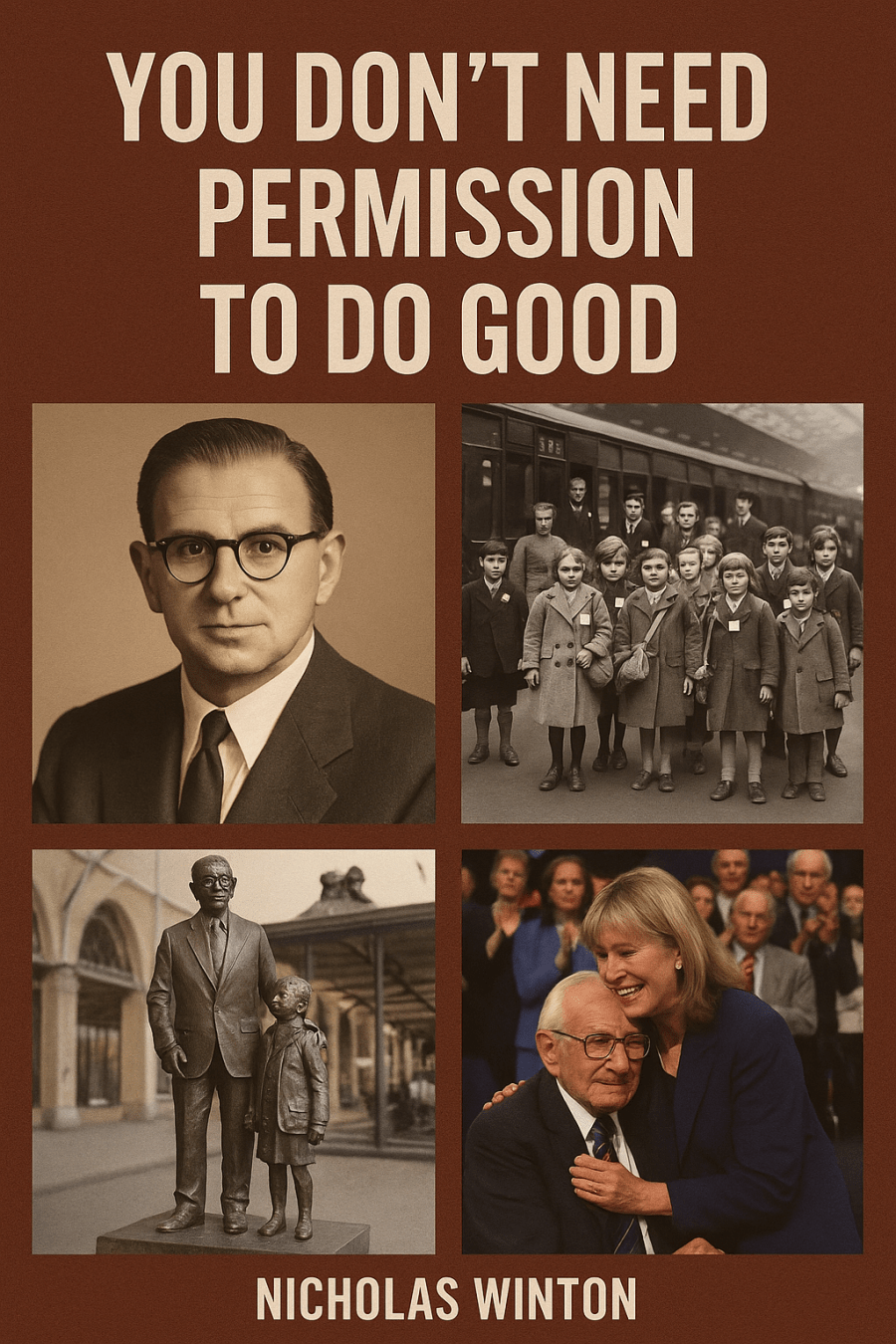
“In 1938, while many planned their holidays, this young London stockbroker made a decision that changed hundreds of lives. Nicholas Winton traveled to Prague to rescue children trapped under Nazi terror. Six hundred and sixty-nine of them.”
A murmur rippled through the audience. Nicholas shifted uncomfortably.
“I don’t like a fuss,” he muttered.
Esther’s voice softened.
“He forged documents. He convinced families. He arranged trains. And then… he returned to his life, never telling anyone—not even his closest friends. But tonight,” she paused, “we have a little surprise.”
Nicholas blinked. A surprise?
She turned to the audience.
“May I ask… is there anyone here tonight who owes their life to Nicholas Winton?”
The woman sitting right next to Nicholas rose to her feet. Nicholas turned toward her, confused. She smiled through tears.
“My name is Eva,” she said, voice trembling. “I was on the third train. I was five years old. You saved me.”
Nicholas froze. His throat tightened.
Then a man behind him stood up. And another. And another.
Row after row.
The entire studio audience was on its feet.
Nicholas’s vision blurred as faces surrounded him—some gray-haired, some still holding hands with their children, their grandchildren sitting in the rows behind.
“I… I don’t…” he whispered, overwhelmed.
Esther leaned closer,
“Mr. Winton, this… is your family.”
Nicholas felt the room tilt. Decades of silence cracked open like a floodgate.
December 1938 — Prague
Snow fell in soft whispers outside the dim hotel room. Nicholas bent over a wooden table, stamping forged papers with shaking hands.
“Are you sure this will work?” asked Martin, his Czech friend.
“No,” Nicholas replied without hesitation. “But doing nothing will certainly fail.”
The door burst open. A Jewish mother, Ruth, clutched a small girl in a red wool coat.
“Please,” she begged, “take her. Take my Miriam.”
Nicholas crouched, looking into the child’s wide, tear-filled eyes.
“I promise,” he said softly, “I’ll keep her safe.”
Behind him, stacks of passports lay half-finished. He hadn’t slept in days. Yet he signed, pleaded, negotiated. He believed the trains must run. Even when the world seemed determined to stop them.
August 1939 — Liverpool Street Station, London
The train hissed to a halt. Tiny faces pressed against frosted windows. British foster families waited nervously. Miriam stepped down, clutching her small suitcase and a photograph of her parents.
A woman in a green hat knelt to hug her.
“Welcome home, darling,” she whispered.
Behind the platform, Nicholas stood unnoticed, hands in his pockets. Watching. Quiet. He didn’t need applause. He only needed the children to step off the train alive.
1988 — BBC Studio
“Miriam,” Esther called, “please stand up.”
A woman with silver hair rose from the front row, tears running down her cheeks.
“I was that little girl in the red coat,” she said. “I never got to thank you.”
Nicholas felt something shatter inside him—the wall he had built for fifty years to keep the memories contained. His lips trembled.
“I didn’t do anything special,” he whispered, voice breaking.
Miriam shook her head, her voice steady.
“You gave me a life. My children. My grandchildren. All of us standing here today… we are your legacy.”
The applause grew thunderous. The studio blurred into light and sound.
Nicholas lowered his head, tears streaking down his cheeks.
“I only did what anyone should have done,” he whispered.
Grete leaned over and whispered in his ear,
“Not anyone, Nicky. You.”
The host approached gently, her own eyes wet.
“Sometimes heroes don’t wear capes. Sometimes, they just carry a typewriter and refuse to look away.”
Nicholas looked up and saw not strangers—but hundreds of faces that carried a piece of his courage.
And for the first time in fifty years, he allowed himself to feel the weight of what he had done—not with pride, but with quiet, overwhelming love.
Epilogue
Nicholas Winton lived to be 106. He received medals, knighthoods, and applause around the world. But in his heart, the truest award came that day in the studio—a room full of lives that almost weren’t, standing as living proof that one person’s choice to act can echo through generations.
“If something’s not impossible,” he once said, “there must be a way of doing it.”
And he proved it.
Paper boats
Boats are safe on shore but they weren't built for that – I set my sail in the ocean of words
 Paper boats