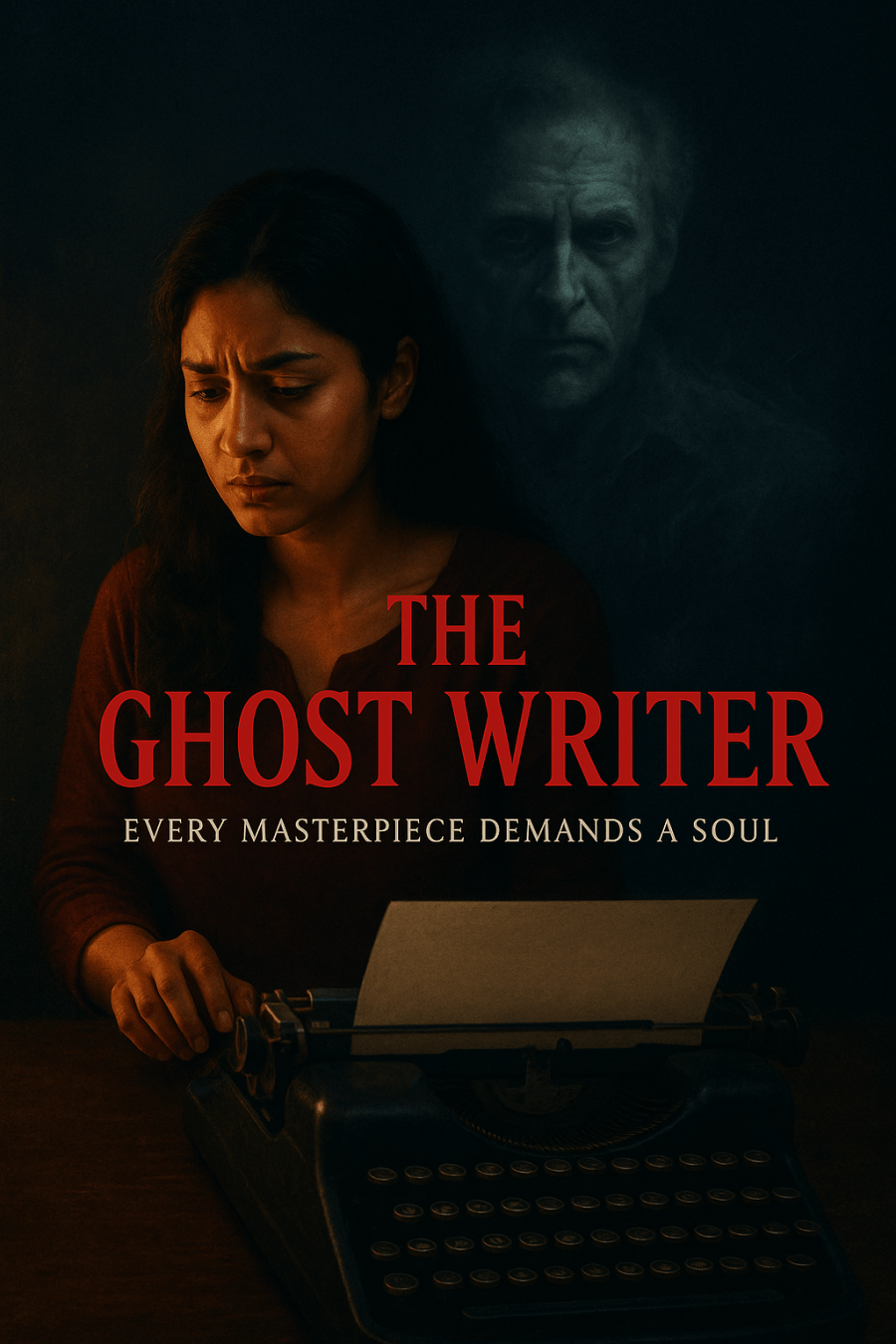
The Ghost Writer
A Short Story by Vasu Gangapalli
—
The cursor blinked like an impatient heartbeat.
Riya stared at the empty document on her laptop screen. Midnight had long passed, and yet not a single word had come. Her small rented room smelled of coffee and desperation. Manuscripts lay scattered everywhere — unfinished, unwanted.
“I’ve got stories,” she whispered. “But no one listens.”
Her gaze drifted to the old typewriter she’d bought at a flea market that afternoon — bronze keys, delicate engravings, a nameplate that read Jonathan Hale.
The vendor had said it once belonged to the legendary novelist who disappeared half a century ago, leaving his last novel unfinished.
Riya chuckled bitterly. “Maybe some of your genius is still trapped inside.”
She pressed one key playfully.
Click.
Nothing.
“Guess not.”
Then the air turned cold. A faint scent of burning paper filled the room. The light flickered once, twice—then the typewriter moved on its own.
Click. Clack. Click.
Words appeared:
“Be careful what you wish for.”
Riya froze. “Who’s there?”
Clack-clack-clack.
“You called. Jonathan Hale.”
Her breath caught. “You’re joking.”
“I’m a writer, not a comedian,” the keys answered. “You want help, don’t you?”
Riya’s fear gave way to intrigue. “You can help me… write?”
“If you’ll let me.”
For the next few weeks, nights became a blur of feverish creation.
Hale dictated stories through her mind — poetic, powerful, profound. Riya’s fingers danced over the keys as though possessed, the words spilling like silk.
Her new novel, The Hollow Dream, was finished within a month.
When it was published, it exploded across the literary world. Critics hailed it as “a masterpiece of a generation.”
For Riya, success felt intoxicating. Her face was on magazines, her name in every review. The girl who once couldn’t find her voice was now celebrated as a genius.
But fame came with whispers in the dark.
Sometimes, she’d wake to find new pages written overnight. Sometimes, she’d speak words that weren’t hers — sentences that carried Hale’s cadence, his cold precision.
And always, that faint scent of burnt paper lingered.
One evening, she sat before the typewriter again.
“Jonathan, I can’t do this anymore. You’re in my head all the time.”
The typewriter keys moved fast, furious.
“Because you invited me in. You wanted brilliance — and brilliance needs a vessel.”
“I didn’t agree to this!”
“You agreed the moment you typed with me. The moment you felt alive.”
“You’re stealing my words!”
“No, Riya. We are sharing them. You breathe; I write. You live; I remember.”
Riya’s tears fell on the keys. “You tricked me.”
“Every writer trades something,” he typed. “Time, sleep, sanity. You traded your solitude. That’s all.”
But she knew it was more. Every day she felt less herself — her voice softer, her memories dimmer. When she looked in the mirror, she almost saw him.
Desperate, she tried to end it.
She packed the typewriter in a trunk, locked it, and buried it in the backyard of her building under the cover of rain.
That night, she slept for the first time in weeks.
Until 3:00 a.m.
When she woke, she found the typewriter back on her desk — dry, gleaming, waiting. A fresh sheet of paper sat inside.
Words appeared, one by one:
“You cannot bury a story once it’s written.”
Riya screamed and threw it across the room.
The windows burst open. Pages of The Hollow Dream flew out like white birds, scattering into the night.
Her body trembled. Her voice cracked. “What do you want from me?”
“Immortality,” Hale’s voice whispered through the wind. “And you shall have it too.”
Then darkness swallowed her.
Days later, her best friend Meera came knocking. The door was unlocked.
Inside, the apartment was eerily still. The typewriter sat on the desk with a single new page.
Meera’s hands shook as she read it:
“The story continues.”
There was no sign of Riya — except for her reflection, faintly visible in the typewriter’s metallic surface, as if captured mid-breath.
Months passed.
A manuscript arrived at Riya’s publisher’s office — The Forgotten Symphony. No return address. Typed, of course.
It was brilliant.
Too brilliant.
It read like Riya’s soul laid bare — yet deeper, older, haunted. Critics called it “beyond mortal comprehension.”
The dedication page read:
To Jonathan Hale — for never letting me stop writing.
But under certain light, a second line shimmered faintly, almost like a secret signature:
And to Riya — for giving me life again.
A year later, a new writer named J. Hale emerged on the literary scene. His books bore uncanny echoes of Riya’s voice — her tone, her themes, her signature imagery.
When readers searched for him, no one could find a photograph. Only an old symbol of a typewriter stamped on the author’s page.
And sometimes, at midnight, when new editions of The Hollow Dream went to print, the press operators swore they heard two sets of keys typing together — one fast and fierce, one trembling, almost human.
Meera never stopped searching for her friend.
Years later, she revisited Riya’s old apartment, now abandoned. Inside the dusty room, she found the same typewriter.
A sheet of paper sat waiting.
It read:
“Do not mourn me. I found my words — but I lost my voice.”
“Tell them… every story has a price.”
Below it, two signatures were etched —
Riya Das
Jonathan Hale
The ink shimmered faintly, as if both names were still being written.
Riya had become what she always wanted — a writer whose words never died.
But in doing so, she crossed the thin, invisible line between creation and possession, ambition and surrender.
Jonathan Hale got his immortality.
Riya got hers — trapped forever in the pages she wrote.
And if you listen closely, on quiet nights, you might still hear the faint rhythm of keys from an old apartment window —
two souls writing together,
forever bound by their art.
Paper boats
Boats are safe on shore but they weren't built for that – I set my sail in the ocean of words