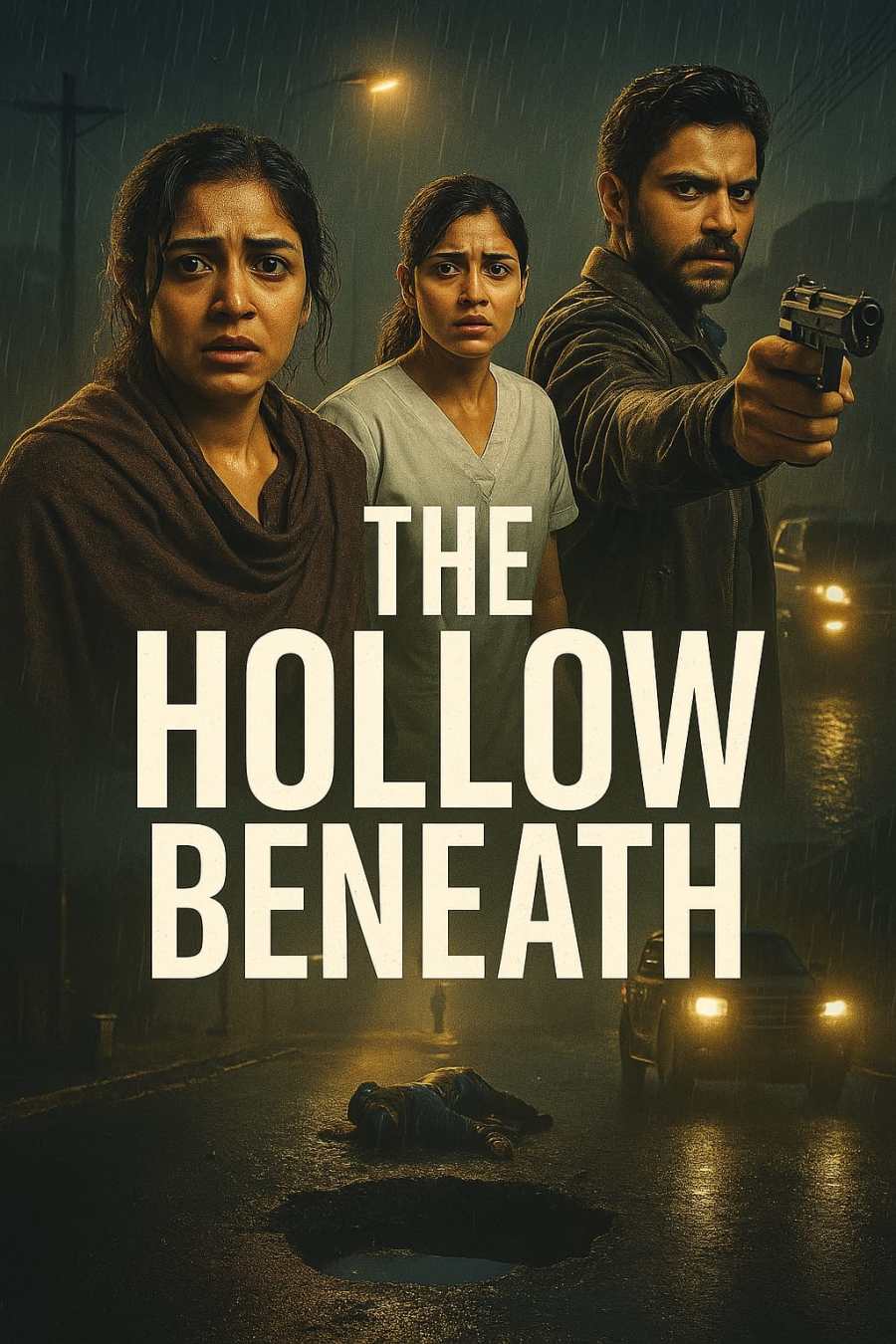
The Hollow Beneath
A Short Story by Vasu Gangapalli
Word count: 1,590
The night rain hadn’t stopped. A single streetlight flickered near the bus stop as Meera tightened her shawl and stepped over the puddles.
Her heel landed in something soft. She jerked back. The same gaping pothole, bigger now, glistened like a trap.
She hissed under her breath. “One day, someone’s going to die here.”
A woman in a nurse’s uniform — Sana — ran past her, skidding dangerously close to the hole. Meera instinctively grabbed her arm.
“Careful!”
“God! That was close,” Sana panted. “Every night this stupid road tries to kill me.”
Before they could move, a scooter zoomed in, hit the pothole, flipped. The rider slammed hard against the divider. Blood pooled fast.
Meera’s hand shook as she dialed for help. Sana knelt down to check his pulse. “He’s alive… but not for long if we don’t hurry.”
The ambulance came late, but they managed to save him in nick of the time.
By morning, they’d filed a complaint. By evening, it was buried under “pending cases.”
“No CCTV, no accountability,” Sana said bitterly.
“Then we’ll make noise,” Meera replied, eyes hardening.
The next day, they returned with shovels, stones, mud, and a bag of quick-dry cement. It was drizzling again, but they didn’t care. Sana removed her sandals, rolled up her pants, and stepped into the pothole.
“This is insane,” Sana laughed breathlessly.
“Maybe,” Meera said, packing the stones in. “But at least no one will die here again.”
They worked for over an hour—hauling debris from the side of the road, leveling the ground, pouring water carefully.
A college student on a bike slowed down, watching them. He pulled out his phone and began filming.
Within minutes, other passersby joined in, handing over sand, bricks, even a spare shovel. The boy posted the video to YouTube with the caption:
“Two women fix what the city ignores.”
By nightfall, it went viral. Thousands of shares, news outlets calling it “citizen power.” And the next morning, for the first time, municipal officials actually turned up—too late to claim the credit.
But even as Meera wiped sweat from her forehead and Sana leaned against the barricade, a black SUV with tinted windows parked nearby caught Meera’s eye.
“They’re watching us,” she whispered.
“Who?” Sana asked.
“Someone who didn’t want this fixed.”
Two weeks later, Sana dragged Meera to a famous street food stall.
“You need a break,” Sana said.
As Sana bit into a samosa, she gagged. “Bitter…”
A man behind them collapsed, foam around his lips. Chaos erupted. Meera dashed behind the counter and tore open oil packets — labels scratched out, oily residue thick and black.
A voice barked, “Step away.”
A tall man with a sharp gaze flashed an ID card.
“Aarav Sharma — Food Safety Bureau.”
“This oil’s laced,” he muttered, examining it. “This isn’t just spoilage. This is sabotage.”
Aarav coordinated with the emergency unit like a machine. Dozens were hospitalized. The stall owner trembled. “I swear, I just bought the stock from the supplier. Same one we’ve used for months!”
“Give me the name,” Aarav demanded.
That night, the three of them — Aarav, Sana, and Meera — met at a deserted café. He placed a photo on the table. A grainy image of the same black SUV Meera had seen earlier.
“That SUV belongs to a shell company that owns this stall’s supplier,” Aarav said.
“Wait,” Meera whispered, “you’re saying the pothole, the oil… are connected?”
He nodded slowly. “There’s a network. And they don’t like noise.”
Outside, someone was watching through the glass. A red dot from a laser pointer briefly flickered on the wall behind Sana’s head.
Late one night, Sana walked alone after a double shift. The road was quiet. Her heartbeat was loud. She noticed a shadow matching her pace.
She texted Meera:
“Someone’s behind me. Sending live location.”
The shadow closed in. A gloved hand grabbed her mouth — but Sana bit down hard and screamed.
Aarav, who had traced her GPS, appeared from the dark, slamming into the man. The attacker’s mask slipped — revealing the same driver from the black SUV.
Meera arrived seconds later, blocking the lane with her bike. “Not this time,” she growled.
Police arrived, but the man was strangely calm, smirking as they cuffed him.
“You think this ends with me?” he whispered to Aarav. “We built the holes you walk on.”
The deeper they dug, the stranger it got. The supplier, the pothole contractor, the SUV, even a few officers in the municipal office — all linked.
Aarav slammed his hand on the table. “They’re using civic chaos to launder money. Fake repairs, fake food checks, real deaths.”
But before they could leak the files Aarav found, his laptop went dark. A single message flashed on the screen:
“STOP DIGGING OR YOU’RE NEXT.”
Meera’s voice trembled. “They know who we are.”
Sana clenched her fists. “Then we fight louder.”
They didn’t go to the police. They went to the media. Livestream. Full exposure. Real names. Faces. Documents.
The story exploded nationwide. Protests flared. The network cracked.
But on the night of their televised interview, a package arrived at Meera’s door. No sender. Just a small piece of asphalt and a note:
“You filled one hole. We dug ten more.”
Meera’s phone buzzed. Aarav’s number.
But when she picked up — silence.
And then—
a single, faint sound: water dripping.
Her hand tightened around the phone.
“Aarav?” she whispered.
No answer. Just the steady rhythm of water dripping somewhere far away. She turned off the lights in her living room, heart pounding against her ribs.
Her mind replayed everything—the pothole, the poisoned samosas, the man in the SUV, the message. She grabbed her keys and rushed out. Sana’s house was closer, but Aarav… something wasn’t right.
The last location Aarav had shared was an abandoned warehouse near the old flyover.
Meera reached Sana’s building, pounding on the door. Sana opened, half asleep, her eyes widening when she saw Meera’s face.
“What happened?”
“He called. But I only heard… dripping.”
Sana didn’t ask further. Within minutes, they were on Meera’s bike, slicing through the night, the city around them eerily quiet.
The warehouse loomed ahead—cracked walls, a sagging roof, one light flickering inside.
“Are you sure?” Sana whispered.
Meera nodded, forcing herself forward.
Inside, the sound grew clearer: drip… drip… drip.
They turned the corner and froze. Aarav hung upside down, bound by industrial rope, a slow trickle of water leaking from a burst pipe above him. A dark stain spread beneath him on the floor.
Sana rushed forward, checking his pulse. “He’s alive.”
“Don’t move.”
The voice echoed from the shadows. The man from the SUV stepped out, not alone this time. Two others followed, faces masked.
“You should’ve kept quiet,” he said smoothly. “You think exposing us will stop anything? We are the roads you walk on. The food you eat. The silence around your screams.”
Meera’s jaw clenched. “You’re a parasite.”
“No,” he smiled coldly, “we are the system.”
Sana whispered, “They’re stalling. They didn’t kill him yet for a reason.”
Meera scanned the room quickly—one broken window, a rusted water tank, loose cables, two metal drums. Her pulse sharpened into resolve.
“You dug holes,” she said slowly. “But we learned to build bridges.”
She grabbed the hanging chain beside her and yanked. The chain swung, knocking over one of the drums, which crashed into the masked men. In the split second of confusion, Sana pulled out a small stun device she carried from her hospital’s night shift.
Sparks burst. One man went down.
Aarav, half-conscious, twisted his body enough to loosen the rope. Meera lunged forward, cutting him free with a jagged piece of metal.
Alarms blared as the old sprinkler system triggered—water everywhere, blinding and cold. The SUV man swung at Meera. She ducked, grabbed a rusted rod, and struck his knee. He howled in pain.
Sana kicked his mask off, revealing a face both of them recognized.
Meera gasped. “He’s not just some thug… he’s the ward officer.”
The same man who’d promised to fix the pothole.
Aarav spat blood, steadying himself. “Of course. Who else would profit from both the problem and the contract to fix it?”
The police sirens wailed outside, but the SUV man laughed.
“You think this ends with me? I’m just one crack in the road.”
Aarav stepped closer, his voice low but steady. “Cracks can be sealed. You forgot that.”
The police stormed in. The masked men were dragged out. The officer screamed threats all the way to the van. But Sana, Meera, and Aarav stood in silence—wet, shivering, alive.
In the weeks that followed, their livestream went viral. Investigations tore through the civic networks like a wildfire. Dozens of contractors, officers, and suppliers were arrested. The “pothole mafia” became a national headline.
But the victory wasn’t loud. It was quiet, like a deep breath after being held underwater too long.
At the bus stop where it all began, Meera stared at the freshly paved road. Sana handed her a steaming cup of chai. Aarav leaned against the railing, his arm still bandaged.
“Do you think it’s really over?” Sana asked softly.
Aarav gave a half smile. “No. But now they know we’re watching too.”
Meera glanced at the road, at the city lights flickering in the distance. “One hole at a time.”
They clinked their paper cups like a silent pact.
A crow cawed in the distance. Traffic resumed.
And somewhere far away, another pothole filled with rainwater… waited.
Paper boats
Boats are safe on shore but they weren't built for that – I set my sail in the ocean of words