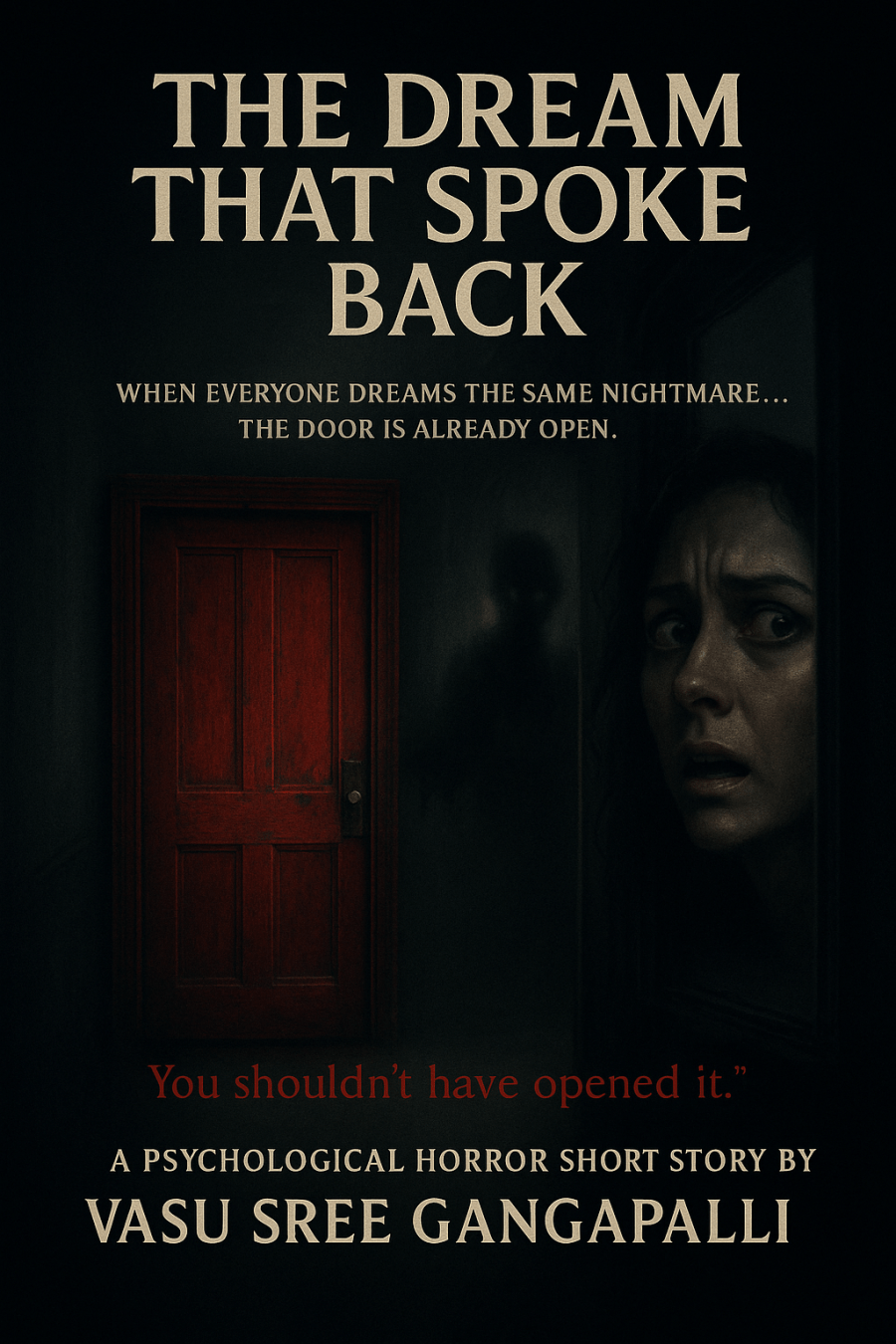
“The Dream That Spoke Back”
A Short Story by Vasu Gangapalli
The clock on Dr. Meera Dev’s clinic wall ticked softly, its sound almost rhythmic against the rain tapping the windowpane. Her 6:00 p.m. appointment—Ananya—sat hunched on the couch, hands clutching the hem of her sweater.
“It’s the same dream,” Ananya whispered. “Every night. The same door. The same knock.”
Meera leaned forward. “The door… Describe it to me.”
Ananya’s eyes flicked to the corner of the room, as if afraid the dream itself might follow her. “Red. Chipped paint. Brass handle. Three knocks at exactly 3:03 a.m. Then…” She swallowed. “Then a voice from the other side says, ‘You shouldn’t have opened it.’ But I never open it. I wake up.”
Meera noted it down carefully, though something about the detail—the time, the voice—unearthed a strange discomfort in her chest. “You’re safe here,” she said gently.
Ananya gave a weak smile, though her pupils dilated in a way Meera didn’t like.
The next day, during her 10:00 a.m. session, Raghav—a former soldier with PTSD—sat rigidly, knuckles white.
“It isn’t a nightmare,” he said flatly. “It’s a message.”
Meera raised her brows. “Tell me what happens.”
“Three knocks. Red door. Brass handle. A woman whispers through it. ‘You shouldn’t have opened it.’ But Meera—” His voice cracked. “The last time, I saw a shadow moving under the door.”
Meera froze.
Ananya had said the exact same words.
By the end of the week, five more patients—none of whom knew each other—described the identical nightmare. Word for word. Knock for knock. Whisper for whisper.
Meera stopped writing it down. She didn’t need to.
It was etched in her brain.
That night, Meera woke up to silence. She stared at her bedside clock.
3:03 a.m.
Knock. Knock. Knock.
Her breath caught in her throat.
The sound came not from the door of her bedroom… but from the inside of her wardrobe.
“No,” she whispered to herself. “This isn’t real.”
She squeezed her eyes shut. “Shared trauma. Contagion. Psychogenic…” She recited diagnoses like mantras.
The knocking stopped.
Then a woman’s voice, soft as silk and sharp as glass:
“You shouldn’t have opened it.”
Her wardrobe creaked.
But she hadn’t moved.
Morning light felt like a weak apology.
In her next session, she didn’t take notes. Instead, she asked abruptly, “When the door knocks… do you ever see what’s behind it?”
Ananya blinked. “No. Because you always wake me up before I can.”
Meera’s pen slipped from her hand. “What?”
Ananya tilted her head slightly. A smile—wrong, too wide—crept over her face.
“You’re in it too now, Doctor.”
Meera staggered back, her throat tightening. The walls of her office—usually sterile white—seemed a shade darker. The clock ticked erratically.
She excused herself mid-session and locked herself in the restroom, splashing water on her face.
“This is delusion,” she whispered. “I’m the anchor. I’m not supposed to fall into their…”
She looked up at the mirror.
Behind her, a red door shimmered where the tiled wall should have been.
Knock. Knock. Knock.
The next few days blurred.
She stopped trusting her sessions. Every patient’s words now felt scripted, rehearsed.
“You opened it.”
“Don’t you remember?”
“You’re the one who let it in.”
Voices bled into her dreams and her waking hours.
She avoided the mirror. She avoided the wardrobe. But the red door began appearing everywhere—reflections, windows, even in the shadow beneath her desk.
Then came the night when she couldn’t resist.
3:03 a.m.
The knocking started, patient and polite.
Her hand moved on its own.
She opened the wardrobe.
Darkness flooded out like a living thing, cold and wet. A hand with fingers too long brushed her face.
A voice, her own voice, whispered:
“It was always you knocking.”
The next morning, Meera didn’t show up at her clinic.
But her patients did.
And each one told the new therapist about the same nightmare.
A red door. Three knocks.
And a woman whispering:
“You shouldn’t have opened it.”
But this time, the woman behind the door was wearing Meera’s face.

