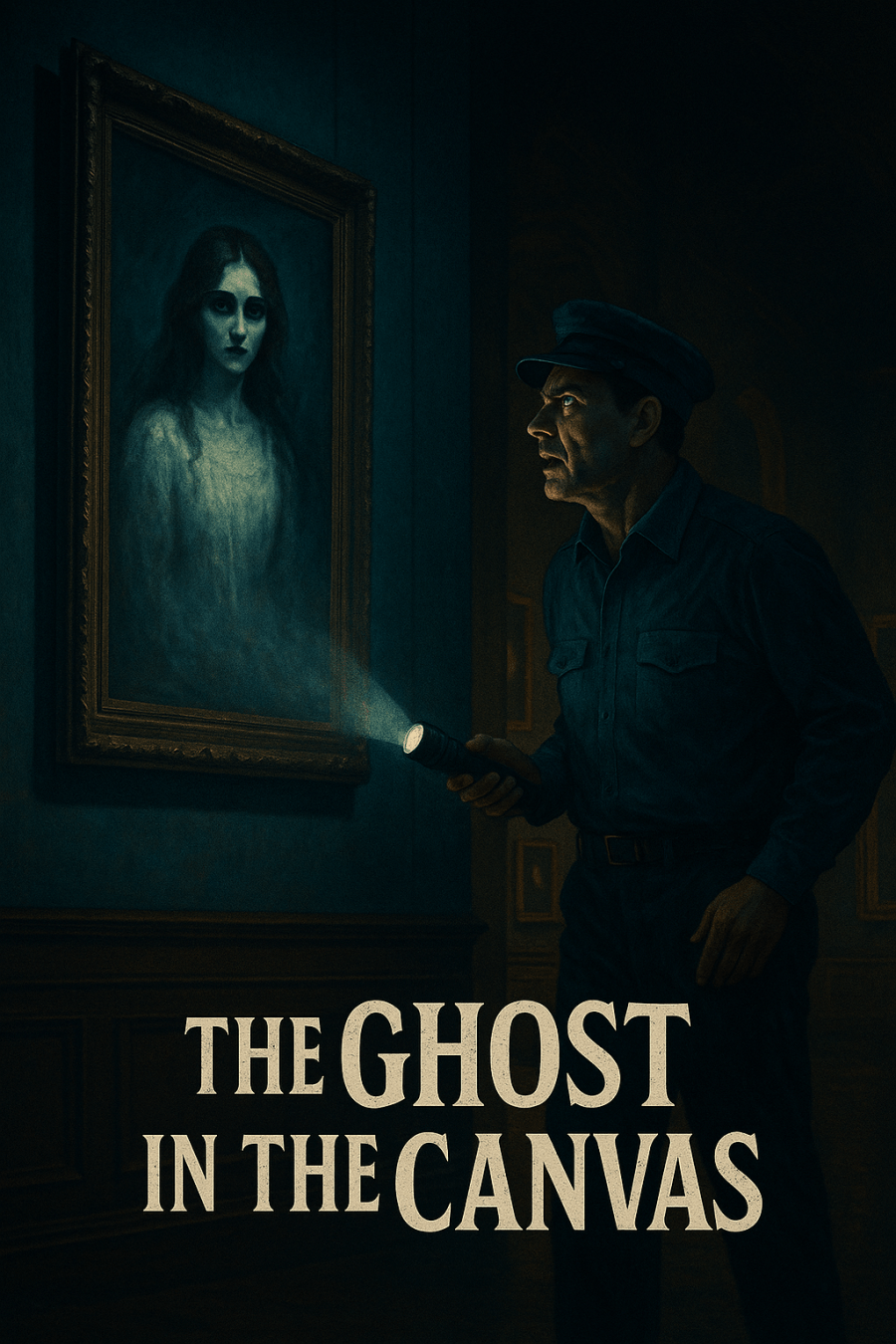
The Ghost in the Canvas
A Short Story by Vasu Gangapalli
The old clock struck eleven as Raghav signed in at the security desk of the city museum. Outside, rain tapped on the glass dome like impatient fingers. Inside, the world was quiet — except for the echo of his boots on marble.
He adjusted his torch and walked past the dimly lit exhibits, the silence wrapping around him like a heavy cloak. His eyes lingered on “The Silent Muse,” the museum’s most famous painting — a haunting portrait of a woman in white, her eyes almost alive.
They said the artist, Elijah Varma, died the night he completed it. No one had ever found the woman he painted.
Raghav swallowed hard. For weeks, he’d felt it — the prickling sensation at the back of his neck, the brush of cold air near the painting. Something wasn’t right.
“Another quiet night, Raghav?”
It was Aarti, the night shift cleaner, pushing her trolley.
“Yeah… quiet,” Raghav muttered. “Too quiet, actually.”
She chuckled. “You and your ghost stories. That painting’s worth ten crores, not cursed.”
When she left, silence returned like a thick fog.
Then — a sharp thud behind him.
Raghav spun. The trolley Aarti had left was moving slowly… uphill… by itself.
The lights flickered.
And then, softly, like the museum itself had exhaled — a whisper.
“Help me.”
The sound came from directly behind him.
Raghav’s flashlight slipped in his hand as he whirled around. Nothing. Empty hallway. Except — the painting.
He stepped closer. The woman’s eyes seemed wetter than before. A glimmer. A tear.
He reached out, hand hovering inches from the canvas.
“Who’s there?” he whispered.
“Not who… trapped.”
The voice was clear now — feminine, sorrowful.
Suddenly — BANG! The fire exit door slammed shut behind him, hard enough to shake the frame from the wall. His heart slammed against his ribs.
His flashlight flickered, then went dead for three seconds. In those seconds, something cold brushed past his arm.
He gasped and stumbled back.
“You’re real,” Raghav breathed, voice shaking.
“He wouldn’t let me go. Elijah… he painted me with his soul.”
The woman in white tilted her head slightly, as if watching him. The frame began to crack.
The motion sensor light snapped on — illuminating fingerprints on the inside of the glass frame.
Raghav ran to the CCTV room, but every gallery feed was static. When he returned, something new had appeared at the bottom of the painting — a signature in fresh crimson.
“E.V.,” he whispered. “That wasn’t there before…”
A painting cart slid across the floor on its own. The gallery door slammed with a violent clang.
“Free me… before he wakes.”
“Who? Elijah?”
“The man behind the brush.”
A male laugh boomed through the hall — low, mocking, as if the walls themselves were laughing.
“Why would I let my muse leave?”
A dark smear began spreading across the opposite wall. The brushstrokes twisted, forming a man’s face — Elijah Varma. His eyes were black voids.
“She’s mine,” Elijah hissed. “She was never meant for your world.”
Suddenly — the emergency light overhead burst with a loud POP! Showering sparks. Raghav flinched.
The woman’s painted eyes darted — yes, darted — to meet his. A flicker of trust in them. A plea.
His fear tangled with something else — resolve.
He grabbed the fire axe. “If this painting is your prison… then I’ll end it.”
Elijah’s shadow lunged from the wall — a black, twisting shape. Raghav felt a cold, bony hand grip the back of his neck. He roared and swung the axe down.
The blade split the frame with a shattering crack.
“NOOO!” Elijah screamed as the painting tore down the middle.
Blinding light erupted — warm, gold, pouring like sunlight into the midnight gallery.
The woman stepped out, barefoot, her dress flowing like mist. The shadow convulsed, then burned away into smoke.
The next morning, the museum called it a theft. But Raghav knew the truth.
Some nights later, he caught sight of her — the woman in white — standing beneath the streetlamp, head tilted up at the stars.
The first nights she’d appeared, she startled him deliberately — whispers in the hallway, footsteps behind him, the cold touch. She’d been trying to scare him away. To keep him safe from Elijah.
But in the end, she trusted him.
One rainy night, as he locked up, she whispered close to his ear — soft as falling rain:
“Thank you for setting me free.”
Raghav placed his hand against the bare wall where the painting once hung. It was warm, like the memory of a touch. He smiled faintly.
The museum no longer felt lonely.
And sometimes, when rain kissed the dome, a light laugh echoed faintly through the halls — playful now, not sorrowful.
She was free.

