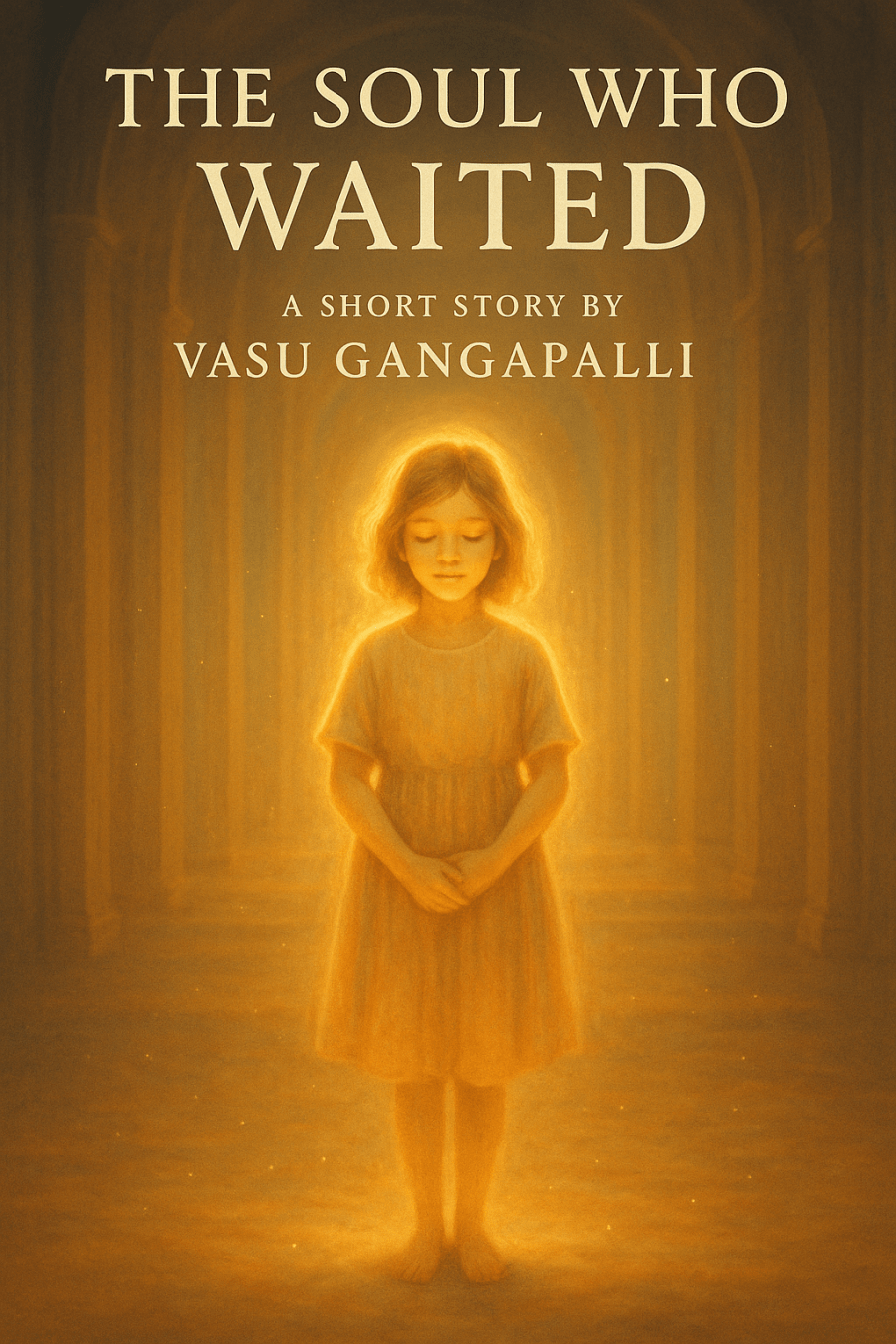
“The Soul Who Waited”
A Short Story by Vasu Gangapalli
There is a place beyond time, where light doesn’t shine, yet everything glows.
It is the Waiting Room of Souls—a realm suspended between lifetimes, between the last breath of one existence and the first cry of another. It is neither heaven nor Earth, but something softer, quieter. A garden of possibilities. A library of fates. A whisper before the world begins again.
Here, a soul named Aara waited.
She was not a child, though she would soon be born as one. Nor was she old, though she carried memories of countless lives. Time didn’t pass here—it folded, reflected, rippled like silk in the wind. Souls in waiting could see ahead, not because they were prophets, but because fate, like a novel already written, lay open before them.
And Aara had read hers.
She knew she would be born in a remote Himalayan village wrapped in mist and silence. She would laugh in snow, run barefoot through monsoon puddles, and sleep to the rhythm of her mother’s lullabies. But her mother would die young—suddenly, in the kitchen one ordinary morning.
At nine, Aara would learn what absence felt like.
She would stop speaking for three months. Books would become her only friends. Words would save her.
She’d win a scholarship to study literature overseas, become a teacher, fall in love with a man whose soul echoed from her past life—yet she’d never marry him. He would leave, choosing a different path, and her heart would quietly shatter.
But Aara would not collapse. She would write.
A novel, born of silence and grief, wrapped in wonder and truth. One that would resonate far beyond her small world. And when her time came, at eighty-three, she would die peacefully under a jacaranda tree, violet blossoms cradling her final breath.
She knew all of it. Every joy. Every ache.
And she still wanted it.
But before she could begin her descent into life, something strange occurred.
—
One evening, as Earth dipped into dusk and the veil between realms thinned, Aara felt a pull. Not from the Source that governed births—but from Earth itself. It was as if a soul, still walking its final steps, had reached out and called her.
She followed.
And found herself inside a hospital room.
The air smelled of antiseptic and finality. Machines beeped like distant drums. An old man lay on the bed, skin paper-thin, hands resting over his chest. Tubes whispered beside him, and his breath stuttered like a failing song.
She stepped closer, though she had no feet. She was light, wind, memory.
Suddenly, his eyes fluttered open.
He saw her.
Not as a hallucination. Not as a dream.
But as truth.
“You’re not my daughter,” he said softly, voice rasping like dry leaves.
“I will be,” Aara replied gently. “Not in this life. But in the one that comes next.”
The old man blinked. “You mean… my daughter’s child?”
“No. Your granddaughter’s child. A long time from now.”
His breath caught. He stared at her, trying to grasp the impossible.
“You’re not born yet.”
She smiled. “No. I’m still waiting.”
“You… know all of it? Your life?”
“Yes.”
“And you still want it?”
“Yes.”
“But it won’t be easy.”
“I don’t want easy,” she said. “I want real. Pain sharpens purpose. Loss opens the heart. Every bruise becomes a poem. Every scar, a sentence. I’ll need them all.”
The old man looked away, tears escaping down his cheek. “My granddaughter… she’s lost herself. Her partner left. She’s afraid to bring a child into the world. She says she doesn’t believe in hope anymore.”
“I know,” Aara said, placing a weightless hand over his. “That’s why I’m here. She’s dreaming of you tonight. She will see you smile. She will remember your kindness. And in remembering, she’ll find a reason.”
“And I…?”
“You will leave peacefully. She will carry your name in her child’s middle name. You’ll live again, in a different form. Through her. Through me.”
The old man wept silently. He didn’t know why he felt so certain, but he did. This wasn’t just imagination—it was divine architecture.
“You are brave,” he whispered.
“No,” she said, her voice like moonlight, “I am ready.”
She leaned in, her face just inches from his. “Thank you… for loving her. For becoming the story that births mine.”
Then, with a soft exhale of light, she vanished.
—
In the hospital room, the man smiled faintly as his final breath left him.
—
Two months later, his granddaughter stood in her kitchen staring at a positive pregnancy test, heart pounding. She had just woken from a dream—the kind that didn’t fade with morning.
In it, her grandfather had held the hand of a glowing girl and said, “Name her Aara. She has a story to tell.”
Tears streamed down her face.
She whispered, “I think I’m ready.”
—
Years later, a girl with curious eyes and an old soul would write stories that felt too wise for her age. She’d talk to shadows, listen to trees, and sometimes pause mid-sentence, as if remembering something from before she was born.
And one day, she would write a story called “The Soul Who Waited.”
And someone—maybe you—would read it and wonder why it felt like more than fiction.
Why it stirred something ancient.
As if part of you had also waited.
And perhaps, you had.
—
The End

