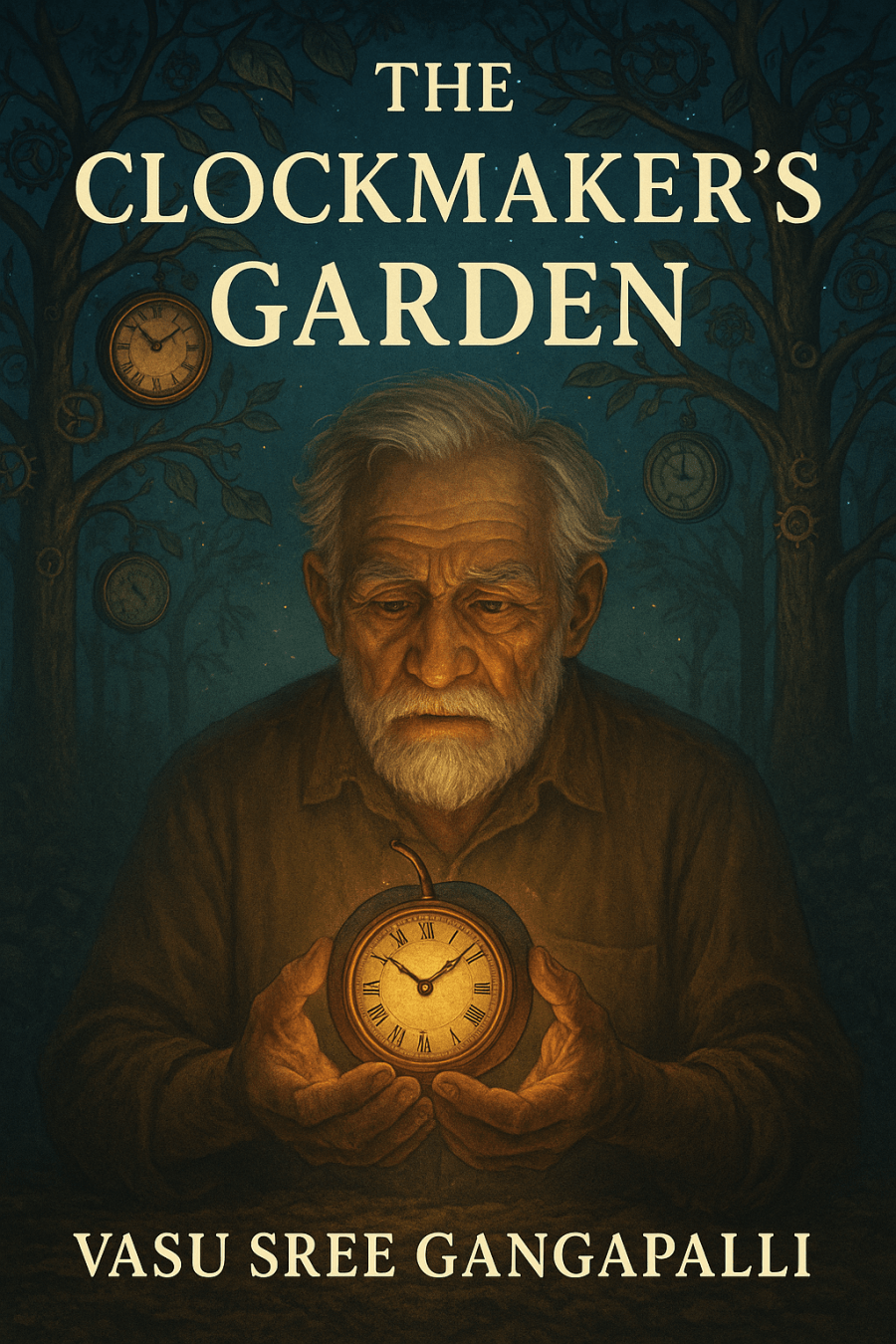
The Clockmaker’s Garden
By Vasu Sree Gangapalli
Raghunath was a man who had lived his life listening to the heartbeats of clocks. Each tick and tock had been his companion in the small shop he had run for forty years. He had mended watches for soldiers who went to war, for brides on their wedding day, for children who wanted to keep time in their tiny pockets. But when his hands trembled with age, customers stopped coming. His shop closed, and silence became his new apprentice.
One evening, as the sun bled orange into the horizon, Raghunath swept the broken watch parts scattered across his workbench. “What good are you now?” he murmured, holding a rusty gear. On impulse, he dug into the soft earth of his backyard and buried the pieces—springs, dials, shattered glass. “Perhaps you’ll find better use there than in my drawer,” he chuckled bitterly.
Weeks passed. Then, one morning, he saw it: a strange sapling glistening with metallic veins. Soon others followed. Their branches shimmered faintly under moonlight. Instead of blossoms, tiny silver fruits hung, ticking faintly like beating hearts. The first time Raghunath tasted one, he nearly wept. In a flash, he saw his own future—an old man, alone, tending to trees that bore impossible fruit. It was exactly what he was already living.
Word of his garden spread like whispers in the wind. Curious neighbors came, skeptics came, and sometimes desperate souls came. One bite, and their eyes widened with visions only they could see. Some left smiling, others crying, a few screaming. Raghunath never asked what they saw. He only handed them the fruit and silently prayed it would not break them.
One sultry afternoon, as Raghunath pruned a tree, a boy appeared at his gate. His clothes were torn at the knees, his face smudged with dust, but his eyes—sharp, restless—burned with something more than hunger.
“Are you… the clockmaker?” the boy asked.
“I was,” Raghunath replied, leaning on his cane. “Now I mend nothing but the soil. What do you seek, child?”
The boy stepped closer. “I want a fruit.”
Raghunath studied him. “These fruits don’t give sweetness. They give truth.”
“I don’t care. I need it.” The boy’s voice cracked. “I need to change my fate.”
Raghunath’s brows furrowed. “The fruit cannot change it. It only shows what lies ahead.”
“But if I know it,” the boy pressed desperately, “I can fight it.”
Something in his trembling voice reminded Raghunath of himself at that age—reckless, determined, afraid of time slipping too fast. Against his better judgment, he plucked a shining fruit and placed it in the boy’s hands.
“Remember,” Raghunath warned, “once you see, you cannot unsee.”
The boy bit into the fruit. His pupils dilated. His lips quivered.
“No…” he whispered. “No, this can’t be me.”
“What did you see?” Raghunath asked softly.
“I saw myself… stealing from a shop. Running. Then—” the boy clutched his chest, gasping— “a man shoots me. I fall. I die in the street.”
He dropped the fruit. It dissolved into the soil like melted silver.
“Give me another!” he pleaded. “Please! I don’t want this!”
“One fruit only,” Raghunath said firmly. “That is the law of these trees. Time doesn’t hand out second chances.”
The boy’s eyes filled with tears. “Then why show me at all? Why curse me like this?”
Raghunath turned away. His own first fruit had shown him a life of solitude, and every word of it had come true. Yet here he was, still breathing. Still capable of choice.
“Because,” he whispered, “knowing the path is not a curse. It is a warning.”
The boy shook his head. “But I can’t escape it. What if no matter what I do, it happens?”
Raghunath’s eyes softened. “Then fight harder. A fruit may show you one thread of time, but you can weave others. Your future is not chains—it is clay. And you must decide what to shape with it.”
The boy wiped his eyes, a flicker of hope breaking through the despair. “Clay…”
“Yes. You have seen the storm. Now you can choose not to walk into it.”
The boy straightened, determination hardening his jaw. “Then I won’t steal. I’ll… I’ll find work. I’ll prove this fruit wrong.”
Raghunath smiled faintly. “Good. Perhaps then the fruit has already changed your fate—not by showing a new path, but by giving you the will to carve one.”
That night, as crickets sang, Raghunath sat beneath his silver trees, his heart heavy with the boy’s desperation. He touched one of the trunks, feeling its faint hum, like the ticking of a giant heart. “Do you truly show destiny,” he whispered, “or do you test it?” Suddenly, one fruit dropped at his feet, rolling to his palm. It glowed brighter than any he had seen before. Against his own vow, he bit into it. He gasped. He saw the boy again—years older, dressed well, smiling proudly as he opened a small shop with his name painted across the signboard. And standing beside him… was Raghunath, frail but alive, the boy holding his hand. The vision faded. Raghunath dropped the fruit, tears streaming down his cheeks. For the first time in decades, he felt the warmth of belonging. “Perhaps,” he whispered into the night, “the boy has saved me, too.”
But peace never lasts long. One night, a man in a fine suit stepped into the garden. His shoes were polished, his smile too smooth, his eyes glinting with greed. “You’re the clockmaker,” he said. “I’ve heard of your orchard.”
“The trees are not for sale,” Raghunath replied.
“Oh, everything is for sale,” the man chuckled. “Imagine—politicians knowing tomorrow’s vote, businessmen seeing next quarter’s profits, generals foreseeing wars before they start. The power to own the future.”
“The fruits are meant as warnings, not weapons. They don’t belong to greed.”
The man plucked a fruit and bit into it, ignoring him. His eyes gleamed with hunger. “In my future, I’m the richest man in the land. Crowds bow before me. The fruit doesn’t lie.”
“It shows one thread,” Raghunath snapped. “But obsession with that thread will strangle you.”
The man smirked. “I’ll be back. And when I am, old man, these trees will be mine.” He vanished into the darkness, leaving the clockmaker trembling.
Days later, the boy returned, brighter, stronger. “Sir, I’ve found work in a mechanic’s shop. It’s not much, but it’s honest. I just wanted to thank you.”
Raghunath’s eyes warmed. “Good. You’ve already changed your story.”
The boy hesitated. “But there’s something else. A man came to the shop yesterday. He asked about you. He said soon the garden wouldn’t be yours anymore.”
That night, under a waning moon, Raghunath walked among his trees. Their fruits glowed faintly, ticking like a thousand heartbeats. He felt both awe and dread. “What have I brought into the world?” he whispered.
The boy appeared, holding a lantern. “Sir, if people like him take these fruits, they’ll ruin everything. Can’t we… stop it?”
Raghunath looked at the trees. His life’s last miracle. His curse and his gift. “I planted them with broken time. Perhaps I must end them before time itself is broken.”
The boy shook his head. “No. They’re not evil. They helped me. Maybe… maybe they exist so people can choose better.”
Raghunath’s hands trembled. He had seen what greed could do. Yet he had also seen what courage could change. He looked at the boy, the only person who had given him hope in years. “Then I’ll trust you. If these trees survive, it must be because people like you guard them, not men like him.”
The boy’s lantern flickered, casting long shadows across the ticking fruit. “Then I’ll guard them, sir. With my life, if I have to.”
For the first time, Raghunath smiled through his fear. And somewhere beyond the walls of the garden, in the silence of the night, footsteps echoed—footsteps of the man who would soon return to claim the fruits of time.
Paper boats
Boats are safe on shore but they weren't built for that – I set my sail in the ocean of words