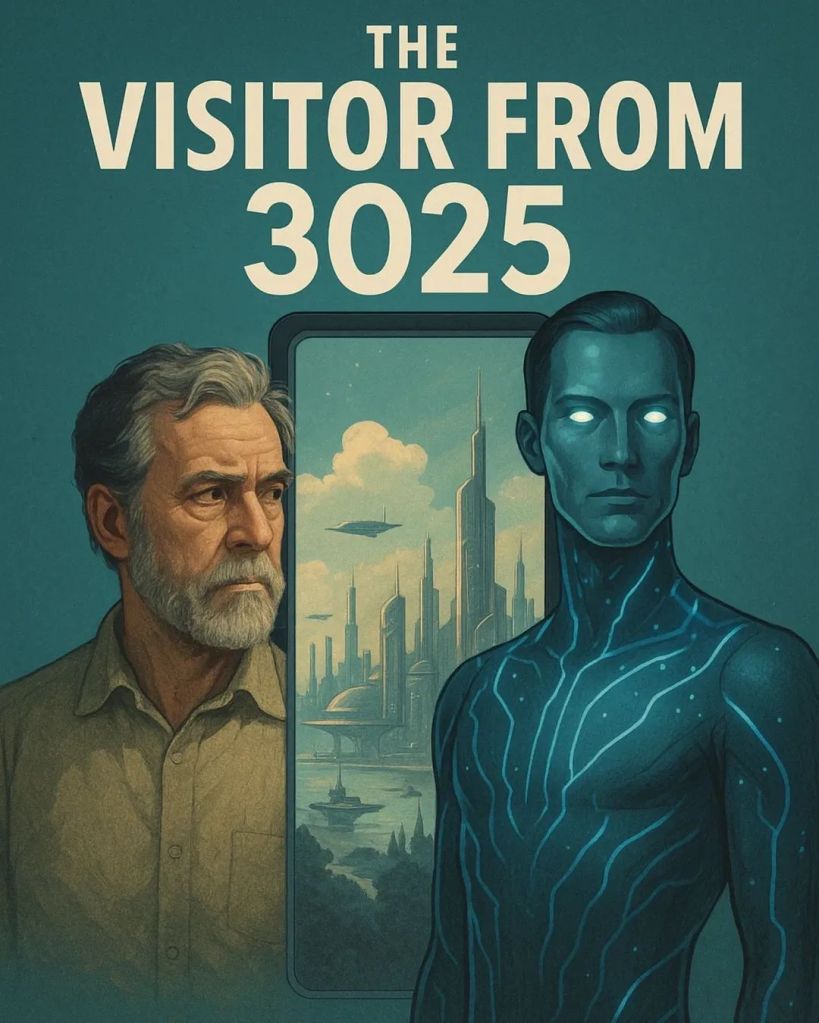
The Visitor from 3025
A Short Story by Vasu Gangapalli
Word Count : 765 words
Frank Willis was not a man easily shaken. A retired physicist with a salt-and-pepper beard and a penchant for antique clocks, he had spent his days tinkering with brass gears and his nights studying the cosmos with his personal telescope. But nothing—not even his years immersed in theoretical physics—prepared him for the man who appeared outside his door on a rainy Tuesday evening in June 2025.
The man was tall, his posture upright like a sculpture carved from air itself. His eyes shimmered like molten silver, reflecting not the room but something far beyond. He wore a seamless bodysuit that pulsed with soft light, like veins of starlight under his skin.
“I am Kael,” he said, voice calm but strangely melodious. “From the year 3025.”
Frank’s first instinct was to call emergency services. But the sincerity in Kael’s gaze— innocent at once—disarmed him. He nodded numbly, welcoming him inside, offered the man hot cup of tea, and sat across from him on his sofa by the fireplace in the living room.
That night, Frank was given a glimpse of the unimaginable.
Kael spoke gently but firmly, as though knowing each word might ripple through history.
“In 3025,” Kael began, “we no longer fight over land or oil or gods. The planet is unified—not by conquest, but by collapse. The century after yours was turbulent. Sea levels rose, systems failed, and humanity nearly devoured itself.”
Frank leaned in, eyes wide.
“But we adapted,” Kael continued. “We built vertical cities that floated above reclaimed oceans. We decoded the language of trees and learned to listen. Nations dissolved. Borders became obsolete. Artificial intelligence evolved—not as rulers, but as guides. They learned not just logic, but ethics, poetry… even silence.”
Frank exhaled slowly. “Silence?”
Kael nodded. “In the future, silence is sacred. We don’t speak unless we must. Thought communication is the norm. Words are art again, not noise.”
Frank sat stunned. “What about… people? Family? Love?”
Kael’s expression softened. “We don’t marry. We bond—sometimes for years, sometimes for days. Children are raised by ‘Pods’—small communities that nurture curiosity instead of obedience. Gender is fluid. Identity is chosen. No child is born unwanted.”
He went on.
“Genetic diseases had been eradicated by 2450. Cancer, Alzheimer’s, and even depression had become stories from a dark past. Energy came from quantum sunlight harvested off-planet. The moon had an entire city carved into its crust—Selenthos. Mars was habitable by 2800. Time travel, Kael claimed, was discovered accidentally in a quantum entanglement experiment. Dangerous. Highly regulated. But sometimes… leaks happened.”
“I didn’t mean to come here,” Kael admitted, sipping the last of his tea. “But now that I have, I see why this time matters. 2025 is when things begin.”
Frank was trembling. “What do you mean?”
“This is your century of choice. The next 75 years decide the next thousand. You must choose science over fear. Unity over ego. Earth over profit.”
Frank stared at the fire, which suddenly seemed much older and smaller than it had an hour ago.
Later that night, Kael walked Frank into the backyard. The rain had stopped. The stars glistened above them.
“You call it Orion,” Kael said, pointing up. “In my time, we call it ‘the memory cradle.’ A memorial to the humans who took the first deep-space leap in 2584. They never came back. But their legacy lives in every system we’ve touched since.”
Frank looked at him, heart pounding. “Why tell me this? Why me?”
Kael looked at him kindly. “Because you’ll tell others. In your way. Not as prophecy—but as wonder.”
That night, Frank dreamed of cities humming above clouds, of voices that flowed through minds like rivers, of forests that taught instead of burned.
The next morning, he woke up early, heart strangely light. He went to knock on the guest room door.
Silence.
He pushed it open.
The bed was empty. Perfectly made. The teacup from the night before was gone. There are no footprints on the damp floor. No trace of Kael.
Just a single object on the pillow: a translucent pebble that shimmered with soft, internal light.
When Frank touched it, a single word bloomed in his mind—not heard, but felt.
“Remember.”
And he did.
Every word. Every image. Every warning and every hope.
Kael was gone.
But the future had visited. Frank would spend the rest of his days not trying to prove it—but inspiring others to imagine it. For he now knew that imagining better was the first step to building it.